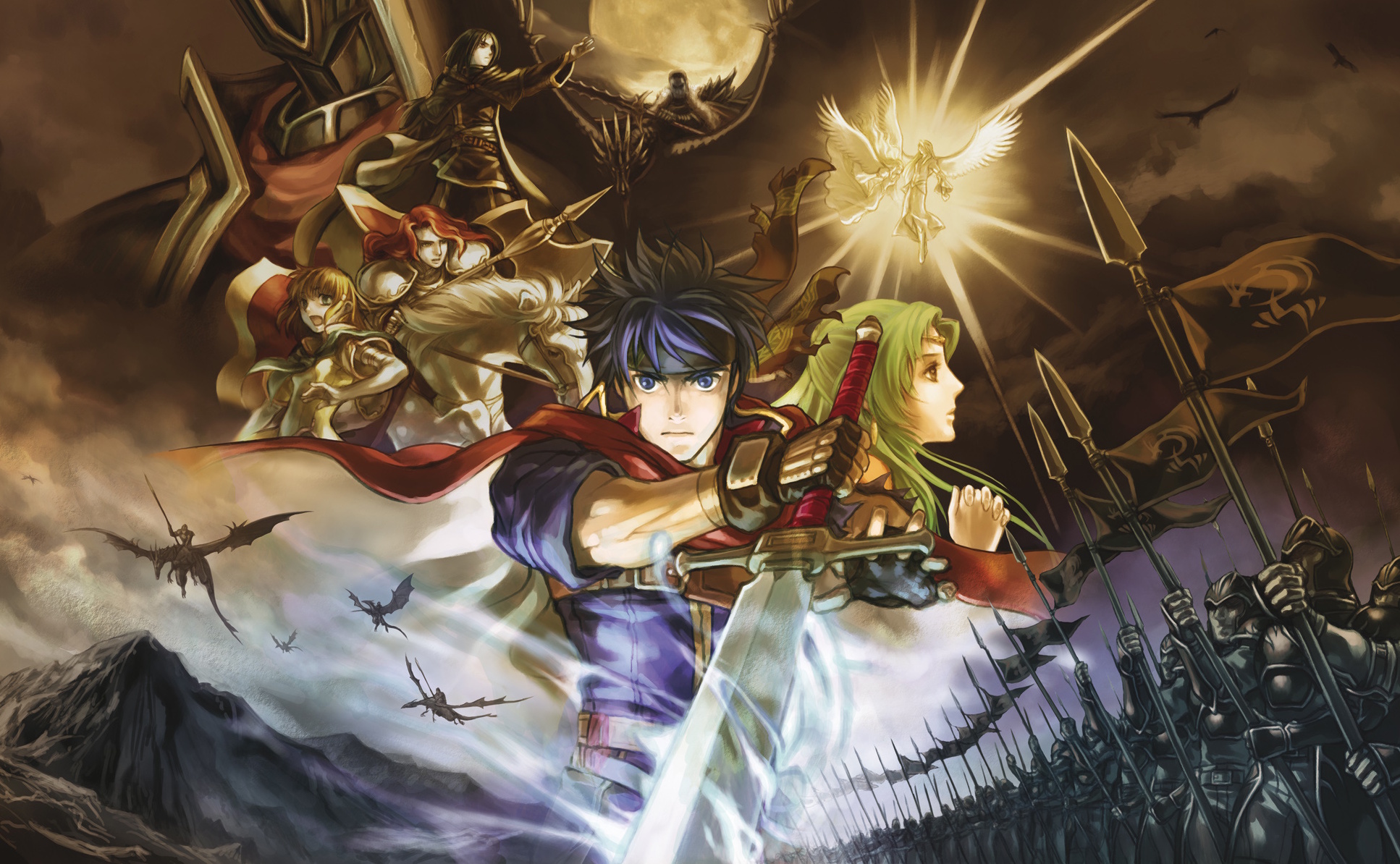
I started Fire Emblem: Path of Radiance mostly because it became available on Switch 2. I had already enjoyed Three Houses, and I was curious to see where the series came from and how much of its identity was already present in an older entry.
The problem was that Path of Radiance did not make a good first impression on me.
I started the game around three different times, and every time I dropped it before even finishing the first act. The opening is slow, the presentation feels dated, and for several hours I was playing more out of historical curiosity than genuine enjoyment. Up until roughly Chapter 8, I was not particularly invested in the characters or the conflict. I simply wanted to understand an older Fire Emblem and see the foundations of a series I had come to appreciate through Three Houses.
Then, somewhere around Chapter 9, something changed.
The story finally began to take shape. The political situation became more interesting, the world started opening up, and I found myself continuing not because I felt obligated to, but because I genuinely wanted to know what would happen next. From that point onward, the game became much easier to appreciate, and by the end I liked it considerably more than I ever expected during those first few attempts.
The gameplay is probably the biggest reason it holds up so well.
Compared with Three Houses, it is obviously simpler. Fire Emblem’s combat systems have evolved incrementally over the years, and newer entries naturally offer more layers, customization and flexibility. But the core combat in Path of Radiance is still remarkably solid. It is simple, readable and consistently satisfying.
What surprised me most was how much I came to appreciate the game’s structure. It is basically a continuous cycle of story scene, preparation, battle, story scene, preparation, battle. On paper, that sounds repetitive. I expected it to become exhausting.
Instead, I found it refreshing.
There is something very pleasant about a game that understands exactly what it wants to be and does not constantly interrupt itself with additional activities simply for the sake of variety. Path of Radiance rarely feels like it is trying to pad its runtime. It gives you a story, lets you prepare your army, puts you into a tactical battle, and then moves forward. That simplicity became one of its greatest strengths for me.
My main problem with the gameplay was the difficulty.
I chose Normal, and I had almost exactly the same issue I had with Three Houses: Normal feels much closer to Easy than to what I would normally expect from a standard difficulty setting. I do not know if this is a recurring characteristic of the series, but the game rarely forced me to engage deeply with all of its systems.
You can play reasonably strategically and get through most encounters without too much trouble. Because of that, I rarely felt pressured to conserve my strongest weapons, optimize every character’s skills, fully understand the forge, or experiment seriously with different builds. The game gives you all these systems, but on Normal difficulty it often feels like you can simply ignore a large portion of them.
That is a shame, because difficulty in tactical games is not only about making the player struggle. It is also what gives their systems meaning. If the game never forces me to think carefully about forging, abilities or resource management, those mechanics become interesting possibilities rather than necessary parts of the strategy.
The characters, on the other hand, were almost universally likable.
Coming from Three Houses, I definitely missed the more developed social side of the experience. Path of Radiance gives you far fewer opportunities to spend time with your army outside of combat, which means it can be more difficult to develop relationships or learn much about certain characters.
Still, the characters I did get to know rarely disappointed me. The cast has a lot of personality, and even without the elaborate social systems of later games, the stronger characters leave an impression. My issue was less that the characters lacked depth and more that the game did not always give me enough opportunities to discover that depth.
The world itself may have been one of my favorite parts of the experience.
Tellius gave me a strange kind of Game of Thrones feeling—not because the plot is particularly similar, but because of the way the world is constructed. Different kingdoms, races, political tensions and historical conflicts give the setting a sense that it exists beyond the immediate journey of the protagonist.
It feels like a real place with its own history.
The conflict between different nations and between the beorc and laguz gives the world a strong identity, and the more the story expanded, the more interested I became in the setting itself. The worldbuilding never felt overwhelmingly complex, but it was strong enough to make Tellius feel distinct and memorable.
One area where the game did disappoint me was the music.
The soundtrack is perfectly functional, but I found much of it repetitive and surprisingly forgettable. Very few tracks stayed with me once I stopped playing. And I do not think this can simply be blamed on the game’s age. Final Fantasy IX and Final Fantasy X, both older games, have extraordinary soundtracks that remain memorable decades later.
So for me, the music is simply one of Path of Radiance’s weaker elements.
My other major disappointment was the ending.
I liked the story. I liked where the conflict went. I liked the development of the world and the characters. But the final confrontation felt strangely anticlimactic.
Without going into major spoilers, I expected something much more dramatic. The story introduces supernatural concepts and hints at forces far larger than the immediate political conflict, so I naturally expected the finale to escalate into something more spectacular: perhaps a godlike enemy, several phases, or at least a final battle that felt fundamentally different from everything that came before it.
Instead, the ending feels almost like another normal battle.
You win, and then the game is over.
That lack of escalation made the conclusion feel smaller than the story surrounding it. It is especially noticeable because the game itself gives you reasons to expect something more supernatural or grandiose.
However, knowing that Path of Radiance has a direct sequel changes how I interpret some of this.
By the end, the game strongly feels like the first half of a much larger story. Many ideas are introduced without being fully explored. Certain aspects of the world, its history and its supernatural elements feel deliberately planted for something that has not happened yet.
Because of that, Path of Radiance almost feels less like a completely self-contained adventure and more like the foundation for Radiant Dawn. I have not played that sequel yet, so I cannot say whether that impression is correct, but the game certainly gives me that feeling.
And perhaps that is also the best way to describe my overall experience with it.
I started Path of Radiance almost as an archaeological exercise. I wanted to see an old Fire Emblem, understand where some of the ideas in Three Houses came from, and move on.
Instead, I ended up discovering a game whose simplicity I genuinely came to respect.
It has a difficult opening, a surprisingly weak soundtrack, an overly forgiving Normal mode and a finale that did not give me the sense of spectacle I wanted. But underneath those problems is an extremely solid tactical RPG with a likable cast, a distinctive world and a gameplay loop that has aged much better than I expected.
At first, I thought Path of Radiance was simple because it was old.
By the end, I appreciated it because it was simple.